
Floyd County Sex Offender Checks
The first official channel is the Virginia Sex Offender and Crimes Against Minors Registry. It covers public information that Virginia law directs VSP to publish. A name search can help when the person is known. County, city, ZIP, street-address, and map-style controls can frame a place-based Floyd County registry review, subject to the labels shown on the live form. Search options can change, so read the current instructions before relying on a saved process.
The registry and a local law-enforcement record serve different roles. VSP publishes the statewide public profile. The Floyd County Sheriff provides the local point of contact for registration instructions and suspected failures to comply. Neither route replaces a court docket or a full criminal-history self-review. A registry listing reflects a statutory registration duty tied to a qualifying offense. It is not a list of all people with Floyd County criminal records, nor does it establish any new conduct.
Floyd County Registry Registration Desk
Local registration questions go to the Floyd County Sheriff's Office at 100 E. Main Street, Room 206, Floyd, VA 24091, by calling 540-745-9334. The county does not publish fixed registry-desk hours or a local fee. Call first for appointment and location instructions. Initial Virginia registration can involve form SP-236, fingerprints, palm prints, a photograph, and DNA within the applicable process. The precise duty depends on the registrant's statutory category and status.
VSP's registry program can also answer state-level questions at 804-674-2825 or sor@vsp.virginia.gov. That division manages the central system. The Sheriff handles the local contact described in the Floyd County research, while VSP controls the public statewide record and program rules. This split matters when an entry appears wrong. A search-display question belongs with VSP; an urgent local safety issue or suspected noncompliance belongs with law enforcement.
Floyd County Sheriff's Office
100 E. Main Street, Room 206
Floyd, VA 24091
540-745-9334
Call for local registration and reporting instructions.
Virginia Registry Searches
Begin with a broad enough query to catch a name variation, then narrow the result through geography and profile details. The public interface requires acceptance of its lawful-use terms where displayed. Do not assume two people with a similar name are the same person. Match the full set of published identifiers, and pay attention to the profile's status and date context.
- Open the VSP registry and read the current disclaimer and search conditions.
- Choose a name or geographic mode. Select Floyd for a county search when that control is available.
- Review the result list for name, location, and other published identifiers before opening a profile.
- Read the full profile, including offense, registration status, address context, and verification information.
| Field Label | Type | Required | Use |
|---|---|---|---|
| Last Name | Text | Depends on mode | Starts a name search; follow live partial-match rules |
| First Name | Text | Optional | Narrows a last-name result |
| County | Dropdown | Geographic mode | Select Floyd |
| City or ZIP | Text or dropdown | Geographic mode | Focuses the location search |
| Street Address | Text | Radius mode | Uses a valid address as the center point |
| Radius | Dropdown | Radius mode | Choose only a distance offered by the live site |
| Disclaimer | Checkbox or button | When shown | Confirms lawful-use terms |
Floyd County Registry Tiers Explained
Virginia's tiers are offense categories set by law. They are not crowd-sourced danger scores, neighborhood votes, or a prediction of future conduct. Sections 9.1-902 through 9.1-908 of the Sex Offender and Crimes Against Minors Registry Act govern classifications and duties. The underlying offense and legal status determine the tier. A reader should not invent a risk label from a tier number.
Duration and removal are also legal questions. An eligible person with one Tier I registration may petition no earlier than the statutory threshold, but passage of time alone does not remove a profile. Tier II has a longer general term, and Tier III is a lifetime category excluded from the ordinary removal petition described in Section 9.1-910. Offense-specific rules still control.
Note: A tier describes statutory registration duties, not proof of a recent crime or a complete account of a person's court history.
Registry Profiles: What They Show
A Virginia public profile can combine identity, appearance, location, vehicle, offense, and compliance fields. The live display controls what is currently public. Some information may be shown only where the statute authorizes it. Read several fields together, especially when names are common. The profile's address can also require date and status context because lawful moves and reporting cycles do not always appear at the same moment.
| Name and Aliases | Current published name and alternate names tied to the registry entry |
|---|---|
| Photo and Description | Photograph plus legally displayed sex, race, age or birth data, height, weight, hair, eyes, and marks |
| Registered Locations | Residence and, when authorized, work or school address information |
| Offense Details | Offense description, Virginia Code section, conviction date, and jurisdiction |
| Vehicle Details | Published make, model, year, color, and license information |
| Registry Status | Registration or compliance status, registration date, and available verification data |
Floyd County Registry Address Context
A registry address should be read with its status and update context. It may reflect a reported residence, a work or school location where public, or another address category allowed by law. A mailing locality may not match a town boundary. Floyd County has one incorporated town and many rural addresses, so a place name alone should not be treated as a separate police jurisdiction.
VSP controls the public registry record. If an address appears stale or a status raises concern, do not confront the person or household. Give the Floyd County Sheriff the profile details and the reason for concern. Use 911 only for an immediate danger. The research does not support a blanket statewide distance rule from schools or parks, so no fixed residency radius should be inferred from the search map.
Registration Levels and Duties in Virginia
Virginia assigns Tier I, Tier II, or Tier III by qualifying offense and statute. Verification frequency depends on category and current legal status, and the research does not supply one reliable universal schedule for every registrant. The table therefore states only the supported duration and removal framework. For a case-specific duty, use the current Act and confirm with VSP or the registering law-enforcement office.
| Tier | General Duration | Public Visibility | Removal and Verification Context |
|---|---|---|---|
| Tier I | Generally 15 years | Statutorily public profile fields appear in the VSP registry | An eligible single Tier I registrant may petition no earlier than 15 years from the later statutory starting event; verification follows current legal status |
| Tier II | Commonly 25 years | Statutorily public profile fields appear in the VSP registry | Offense-specific law and petition limits apply; verify current duties with VSP |
| Tier III | Lifetime | Statutorily public profile fields appear in the VSP registry | Excluded from ordinary removal under Section 9.1-910; verification follows the governing category |
Floyd County and NSOPW Results
A Floyd County search may need a national layer when a person has lived elsewhere or when an address sits near a state line. The Department of Justice National Sex Offender Public Website searches participating jurisdiction records through one federal entry point. It does not replace Virginia's source profile. Use NSOPW to locate possible records, then open and read the responsible jurisdiction's current entry.
The official NSOPW interface provides the cross-state search view shown below. It is useful for geographic breadth, while the VSP registry remains the primary source for Virginia registration details.
View the official NSOPW search interface before comparing a name outside Virginia.
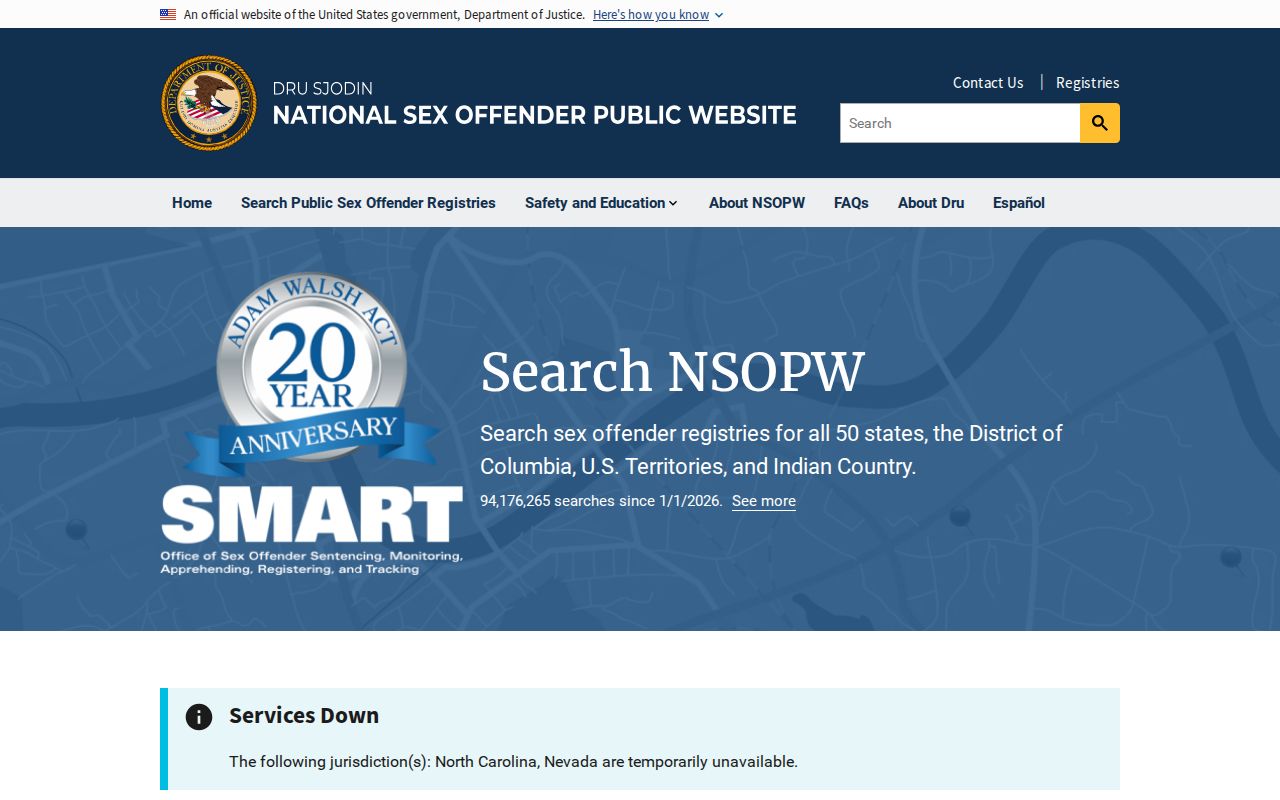
The search screen reinforces a sound two-step method: find the jurisdiction broadly, then verify the live state profile and its status.
Report Floyd County Registry Concerns
Suspected noncompliance should go to trained officials. Save the public profile link or note the displayed name, status, address field, and date observed. Contact the Floyd County Sheriff at 540-745-9334 for a local report. VSP's registry program is available at 804-674-2825 or sor@vsp.virginia.gov for state-system questions. Call 911 when conduct presents an immediate threat.
Keep the report factual. An address mismatch may have an explanation, and a public listing alone does not prove a fresh offense. Law enforcement can compare the report with nonpublic registration records and determine the next lawful step. The county research found no verified Sheriff proximity-alert app and could not confirm registry email-alert enrollment, so neither feature should be assumed available.
Using Registry Information Lawfully
The registry exists for public safety and community awareness. It can help a family understand nearby public records, compare a known identity, or find the correct office for a concern. It does not authorize harassment, threats, intimidation, vigilantism, or discrimination. Readers should rely on the official profile, observe the date and status, and send possible compliance issues to law enforcement rather than acting on their own.
Registry misuse warning: The Virginia Sex Offender and Crimes Against Minors Registry Act governs lawful public access. Threatening, intimidating, harassing, or using registry data for unlawful acts can lead to criminal or civil consequences. Report concerns to the Floyd County Sheriff instead of confronting a registrant or household.
Public fields can be incomplete, delayed, or dependent on statutory display rules. Verify a Floyd County registry result through VSP and the appropriate local office. For a court judgment behind the listing, use the official clerk channel because a registry profile is not the full case file.