
Criminal Court Cases in Floyd County
Floyd County has no municipal court. The Floyd General and Juvenile and Domestic Relations District Combined Court and Floyd Circuit Court divide the local criminal docket. General District Court hears misdemeanors and traffic matters. It also conducts arraignments and preliminary hearings when a felony begins as a complaint. The Circuit Court, part of Virginia's 27th Judicial Circuit, receives certified or indicted felonies, tries felony charges, imposes sentences, and hears appeals from district court. J&DR handles adult criminal matters within domestic-relations jurisdiction, but confidential juvenile information does not appear in the public online case systems.
The Floyd County clerk of each court keeps its case file. That distinction controls where to request a Floyd County order, charging paper, or certified disposition. The Floyd County Circuit clerk serves the public in Room 200 at 100 E. Main Street, while the combined district clerk is in Room 208 at the same Floyd County courthouse. Arrest and booking records have different custodians, so the filed Floyd County court case should not be treated as a copy of a sheriff report or regional-jail entry.
The official combined court directory shows how Floyd County routes its district work.
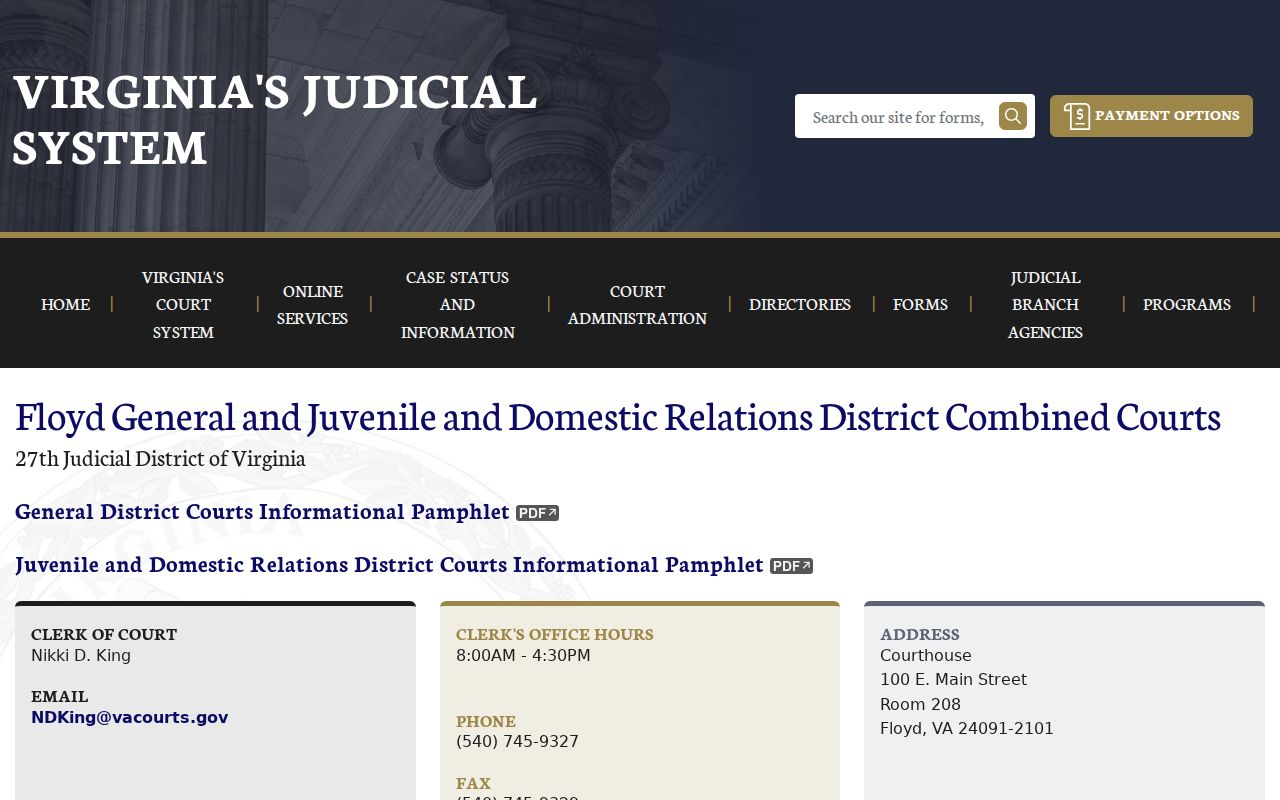
That court listing is the source for the local clerk contact and the weekly district docket schedule.
Floyd County Courts Split Case Work
A quick way to route a Floyd County court case is to ask what stage and charge level the record reflects. Room 208 is the first stop for a Floyd County misdemeanor, traffic charge, or felony complaint still in the preliminary process. Room 200 becomes the key Floyd County counter after a grand-jury indictment, certification to Circuit, or appeal from General District. A person who searches just one Floyd County court can miss half of a felony's path.
Floyd County court days reinforce that split. Circuit Court normally convenes Tuesdays, with terms beginning on the first Tuesday in January, April, July, and October. Grand juries meet at the start of those terms. Floyd County General District criminal and traffic cases are set on Thursdays, and the official schedule notes that no court sits on a fifth Thursday. J&DR matters sit on Wednesdays.
Floyd Circuit Court Clerk
100 E. Main St., Room 200
Floyd, VA 24091
540-745-9330
Monday through Friday, 8:00 a.m. to 4:30 p.m.
Floyd Combined District Clerk
100 E. Main St., Room 208
Floyd, VA 24091
540-745-9327
Monday through Friday, 8:00 a.m. to 4:30 p.m.
Floyd County Case Record Searches
Begin a Floyd County search with the Virginia Judiciary Online Case Information System, or OCIS 2.0. It searches adult criminal information in J&DR courts, criminal and traffic cases in general district courts, and participating circuit courts. Virginia Judiciary warns that circuit coverage is not universal. Floyd County searchers should use OCIS as a broad first pass, then check the direct Floyd County General District and Circuit systems and contact the relevant clerk when a known case does not appear.
- Accept the court system's terms and choose the criminal search scope.
- Search by the defendant's court-record spelling or enter the exact case number.
- Use Floyd as the court or locality and exclude civil results when the interface permits.
- Open the detail record and note the court, charge, status, hearing date, and case number.
- Cross-check the other Floyd County court and ask its clerk for a plain or certified copy when needed.
The OCIS 2.0 landing screen is the statewide starting point for this search.
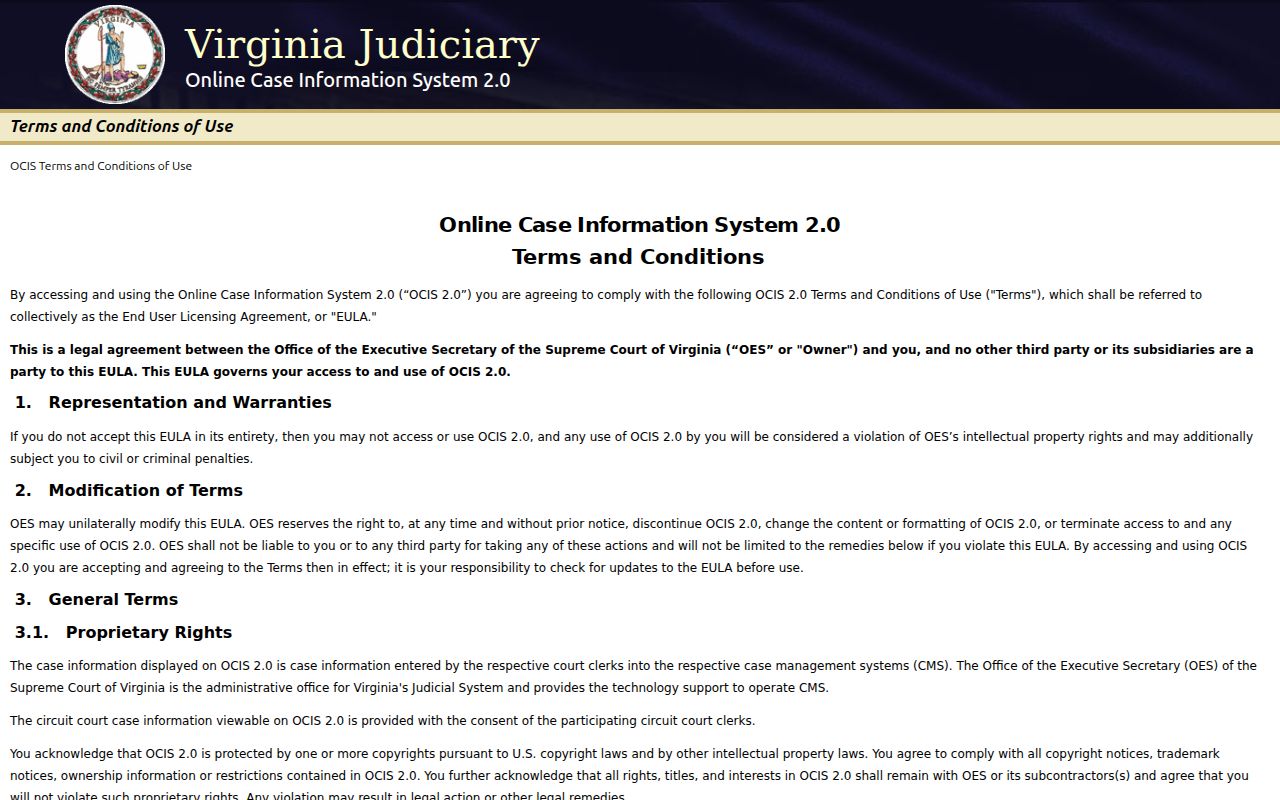
Its statewide reach is useful, but the Floyd County clerks remain the fallback for missing circuit entries and source documents.
OCIS Searches for Floyd County Cases
Names should match the spelling on a Floyd County summons, warrant, or prior court paper. A middle name narrows a common-name result, while a known Floyd County case number is more precise. Hearing-date mode helps when the number is unknown.
| Field Label | Type | Required | Options or Notes |
|---|---|---|---|
| Search Type | Tab or radio | Yes | Name, Case Number, or Hearing Date where offered |
| Last Name | Text | Yes for name | Use the defendant's court-record spelling |
| First and Middle Name | Text | System-dependent | Add details to narrow similar names |
| Case Number | Text | Yes for case mode | Enter the exact court identifier |
| Court or Locality | Dropdown | System-dependent | Choose Floyd Circuit or Floyd General District |
| Case Type | Filter | No | Select criminal or traffic and exclude civil records |
| Hearing Date | Date | Yes in date mode | Use the format shown by the interface |
| Terms or Captcha | Control | Where shown | Accept terms and automated-use limits |
The direct General District Court Case Information system offers the court-specific route.
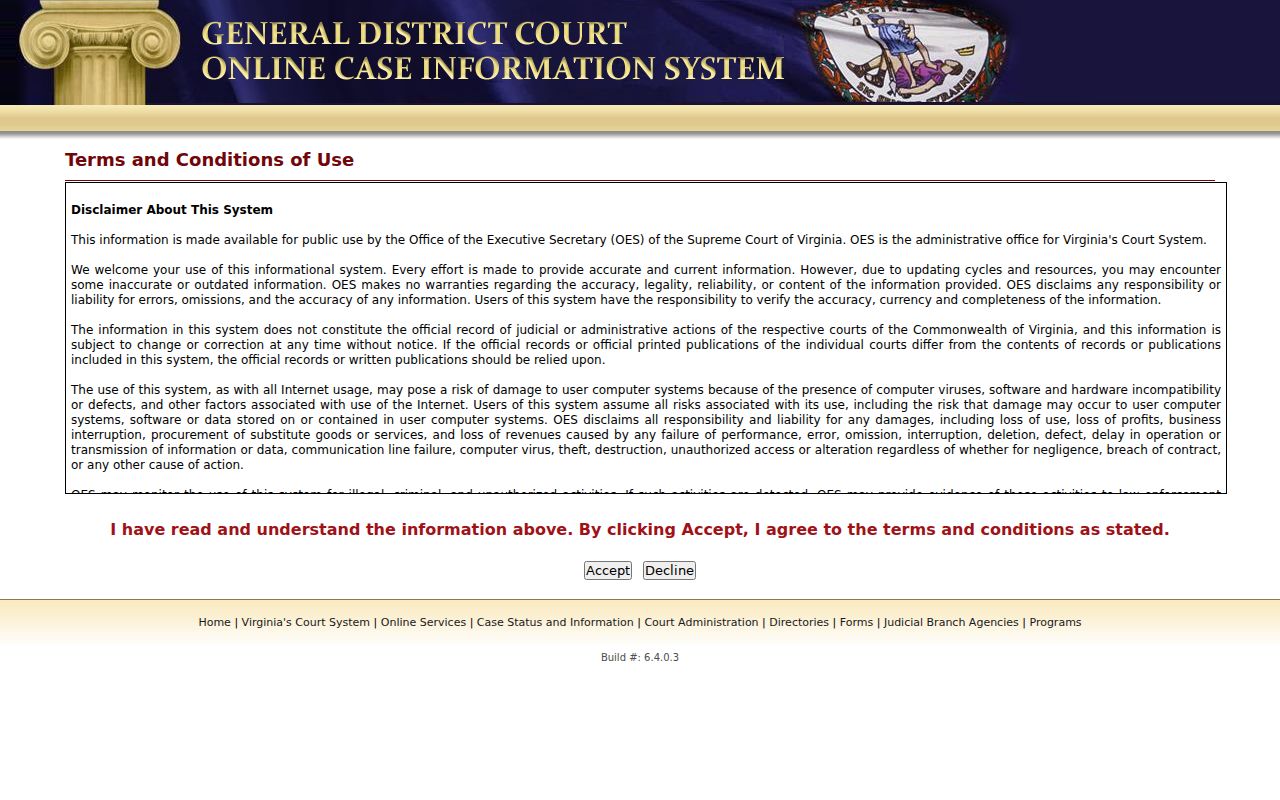
This focused search is especially useful for Floyd County misdemeanors and felony cases that remain at the preliminary stage.
What a Criminal Case File Contains
An online Floyd County docket is an index and status display, not the whole Floyd County clerk file. Results may identify the court, defendant, charge, statute, hearing dates, plea, disposition, sentence, financial assessments, and appeal data. The Floyd County file held by the clerk can also contain complaints, warrants returned to court, indictments, motions, orders, and other pleadings. Public Floyd County case screens generally do not provide downloadable copies of those documents.
| Case Number and Court | Identifies the specific district or circuit file and keeps same-name cases apart. |
|---|---|
| Charging Document | States the alleged offense, authority, and filing basis; it is not proof of guilt. |
| Docket Entries | List hearings, continuances, filed actions, orders, and other events in date order. |
| Plea and Disposition | Shows the formal response and outcome for each charge, including guilty, dismissed, or nolle prosequi. |
| Sentence and Costs | Can show jail terms, conditions, fines, restitution, court costs, and payment status. |
| Appeal Information | Records an appeal and helps explain why later Circuit Court activity exists. |
Full birth dates, Social Security numbers, protected victim data, confidential juvenile information, and sealed material are not Floyd County public-display fields. Each separate Floyd County charge may also have its own result, so one case row should not be used to infer the outcome of every count.
Why Floyd County Felonies Get Two Numbers
A Floyd County felony often starts in Floyd County General District Court after an officer or magistrate initiates process. That Floyd County court handles arraignment and the preliminary hearing. If probable cause is found, the charge can be certified toward Circuit Court. A Floyd County grand jury may also return an indictment. Once the matter reaches Circuit Court, it receives a circuit case number distinct from the district number.
“Certified” describes movement toward Circuit Court. It does not mean convicted. Likewise, an indictment is a formal accusation, not a judgment. Searchers should record both Floyd County numbers and read the disposition at each level. The district entry can close because the felony moved, while the Circuit file contains the later plea, trial, sentence, and appeal events.
- Nolle prosequi
- The prosecutor declines to proceed with that charge at that time. It is not an acquittal.
- Dismissed
- The court ends the charge. The reason and any later filing still matter.
- Certified
- The felony advances from the district preliminary process toward Circuit Court.
- Disposition
- The outcome recorded for a charge, such as guilty, dismissed, or not guilty.
Note: A booking charge can differ from the final filed or amended charge, so use the court disposition for the case outcome.
Criminal Case Stages in Floyd County
Floyd County case records grow as the prosecution moves. A magistrate addresses probable cause and initial release conditions after an arrest. Floyd County General District Court then handles arraignment and either tries a misdemeanor or holds a felony preliminary hearing. A certified or indicted Floyd County felony proceeds to Circuit Court for arraignment, pretrial motions, a plea or trial, judgment, and sentence.
Case flow: Charges Filed › Arraignment › Pretrial › Plea or Trial › Disposition › Sentencing
The Commonwealth's Attorney makes prosecution decisions and presents criminal charges, but that office is not the case-record counter. The Floyd County Commonwealth's Attorney page identifies the prosecutor's official role.
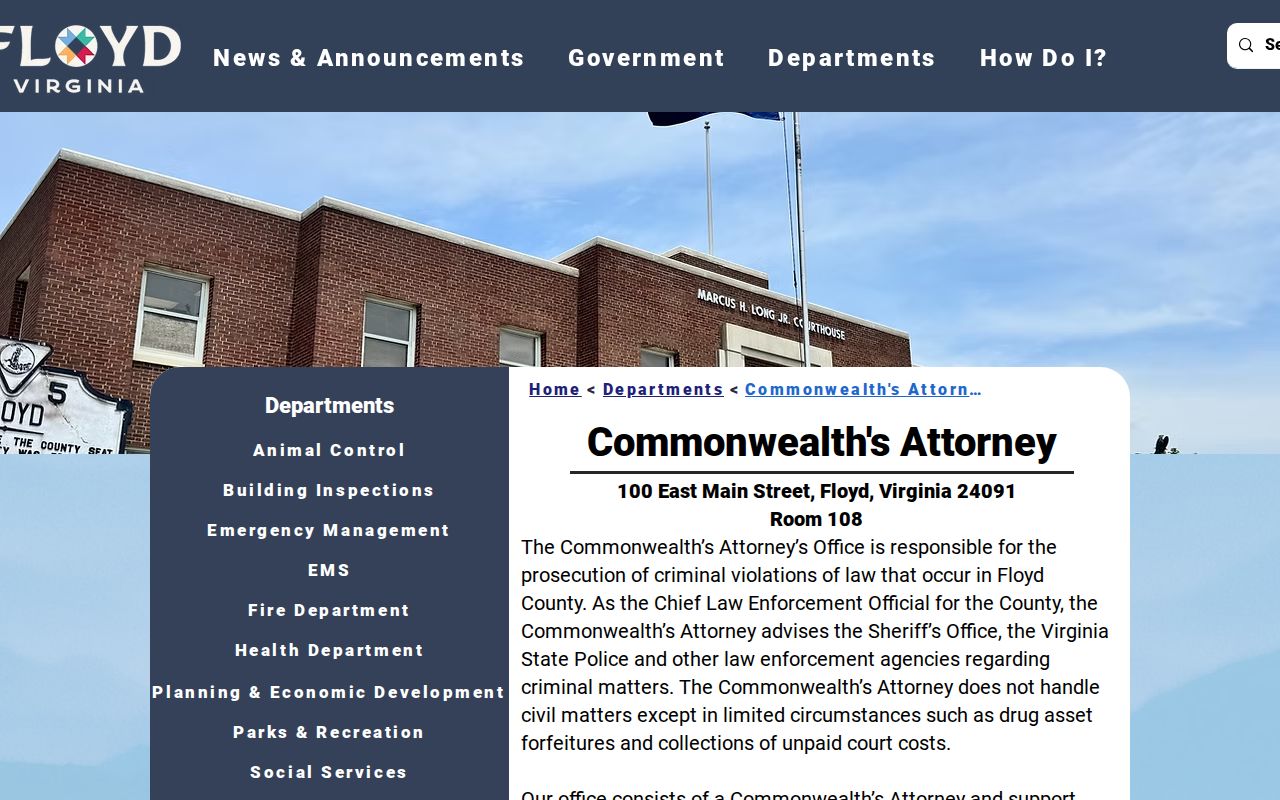
The image helps distinguish the office that prosecutes from the district and circuit clerks who hold the court files.
Certified Floyd County Court Copies
A public online detail can support a quick Floyd County status check, but it is not a certified Floyd County record. Ask the Floyd County clerk that holds the file for the document needed. Room 208 handles district papers; Room 200 handles Circuit pleadings and orders. Supply the Floyd County case number when possible, name the exact item, and say whether a plain copy or certified copy is required. The research did not locate a current official per-page or certification fee for Floyd criminal files, so request a quote before ordering.
Circuit Clerk Rhonda T. Vaughn's office can be reached at 540-745-9330, by fax at 540-745-9303, or by email at rvaughn@vacourts.gov. The public counter is open Monday through Friday from 8:00 a.m. to 4:30 p.m., with recording ending earlier. The district clerk's phone is 540-745-9327. Calling before a visit helps confirm whether a case is in that office, whether an older volume must be retrieved, and what copy method is available.
The county's Floyd Circuit Court clerk page provides the official contact and court-record links.
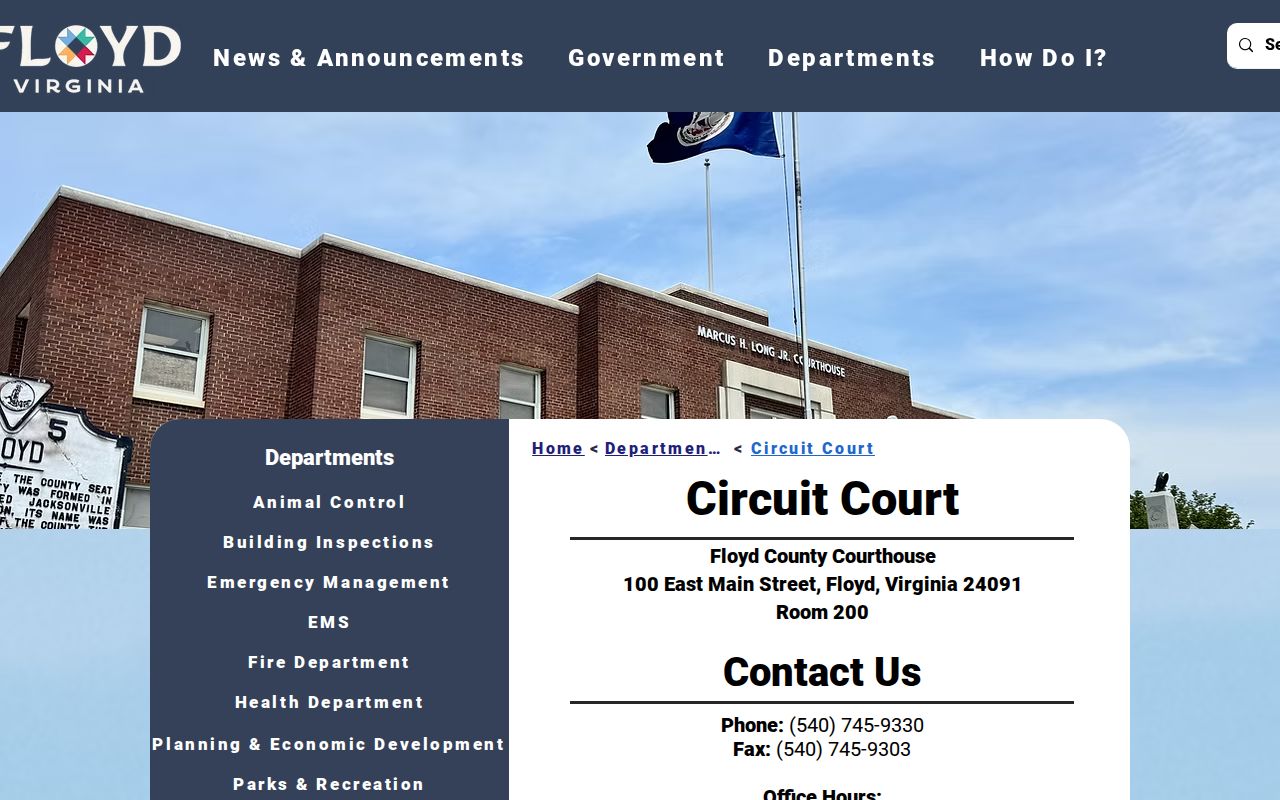
That clerk source is the correct fallback when a Circuit case or its underlying document is absent from the online display.
Older Floyd County Court Case Records
Older Floyd County court records may sit outside the current online index. The correct Floyd County clerk can check bound volumes, archived files, or another local storage route. Historical researchers can also consult the Library of Virginia's Floyd County court microfilm inventory. That Floyd County archive is useful for genealogy and older proceedings, but it does not replace the clerk for a current status or certified case record.
Start with the known court, approximate year, party name, and any case number. If the matter began as a felony complaint, check both district and circuit holdings. Court age, transfer, and indexing practices can affect what is found online. A missing search result is therefore a reason to contact the clerk, not proof that no Floyd County case exists.
Access Rules for Case Records
Virginia Code §17.1-208 addresses clerk custody, inspection, and copies of court records, subject to other law and court rules. Floyd County public dockets can be broader than a disseminated state rap sheet. The CCRE at Virginia State Police links fingerprint-supported Floyd arrest cycles with reported outcomes, but §19.2-389 limits who may receive that compiled criminal-history information and for what purpose.
Confidential Floyd juvenile matters, sealed or expunged files, full personal identifiers, protected victim information, and some active investigative material remain restricted or redacted. Virginia's sealing framework took effect in July 2026, while traditional expungement remains available for specified non-conviction and pardon situations. When an order changes access, verify both Floyd County court levels and the state record rather than assuming each Floyd system updates at the same moment.
Floyd County court access is also separate from a sheriff request under the Virginia Freedom of Information Act. Ask the office that created and holds the record. A court pleading goes to the clerk, an incident narrative goes to the arresting agency, and a booking entry goes to the regional jail. That routing avoids delays and keeps each record in its proper context.