
Floyd Criminal History Checks
No single Town of Floyd database combines police, booking, court, and state records. Start with the event. A local incident report is held by the Floyd County Sheriff. Current detention routes to New River Valley Regional Jail. Misdemeanor, traffic, and felony preliminary records begin with Floyd General District Court, while indicted felonies and district appeals move to Floyd Circuit Court. Virginia State Police keeps the Central Criminal Records Exchange, or CCRE, but does not offer an unrestricted public name-search portal.
A useful Floyd check follows the record through each custodian instead of treating one search result as final. Exact name spelling and a case or report number save time. If a recent booking is absent, allow for release, transfer, a summons, delayed entry, or a name mismatch. If an online court search misses a case, call the proper Floyd clerk because statewide circuit coverage is not universal.
- Identify whether the event was handled by the Floyd County Sheriff or Virginia State Police.
- Request an incident or arrest report from the agency that created it.
- Search the Floyd General District docket for misdemeanors, traffic matters, and felony preliminary steps.
- Check Floyd Circuit Court when a felony was certified or indicted, or when a district case was appealed.
- Use VSP self-review procedures for your own compiled Virginia criminal history.
Why Floyd Records Use the Sheriff
The Town of Floyd does not publish a municipal police department, police records unit, city arrest blotter, or city report portal. Local calls and town incident records route to the Floyd County Sheriff's Office. A state-trooper incident instead belongs with Virginia State Police Division 6. This boundary prevents a common dead end: searching for a Floyd Police Department that the official town and county sources do not identify.
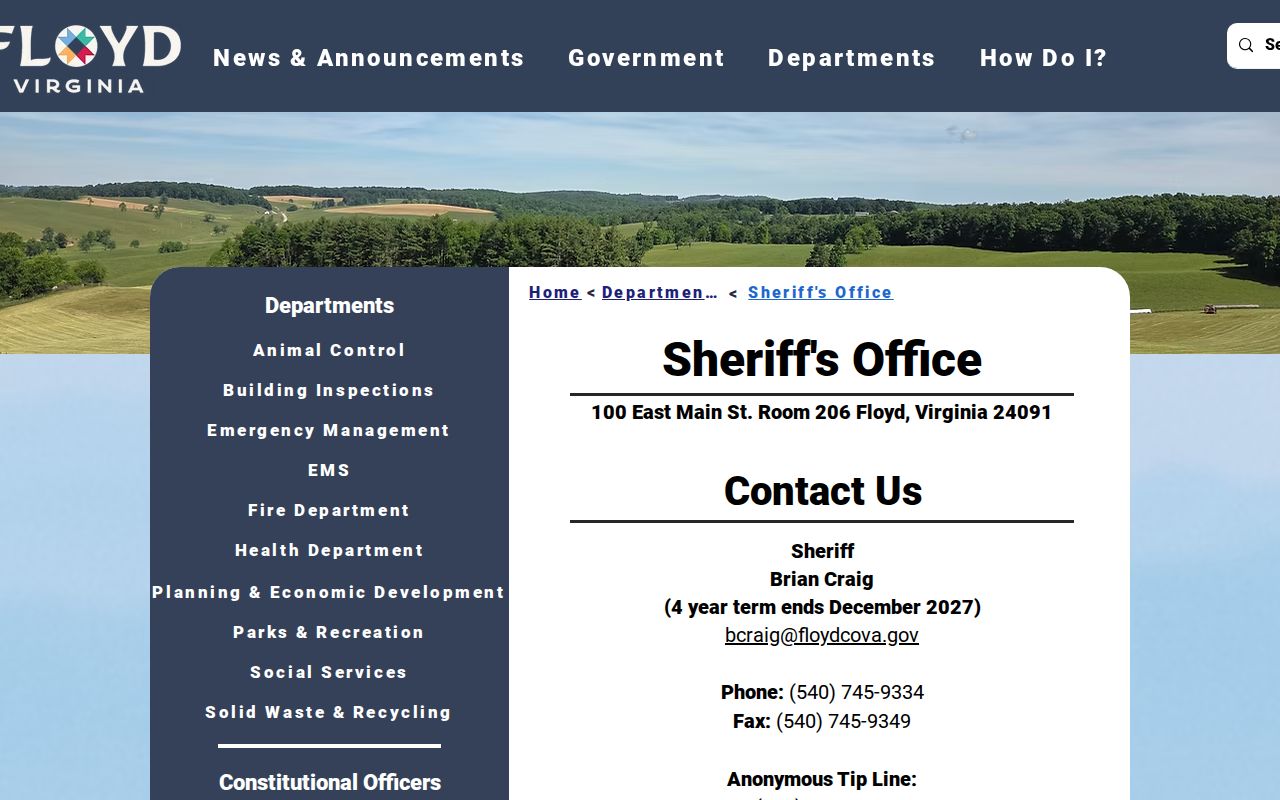
The official Sheriff's page documents the county law-enforcement route shown below. It places the Sheriff's office in the same courthouse used by the county clerks, though each office remains a separate custodian.
For a town event, ask whether a deputy or a trooper made the record. Send the request to that agency and describe an existing document rather than asking an office to create a criminal-history summary.
Records at the Floyd Police Department
There is no Floyd Police Department records counter. The correct local counter is the Floyd County Sheriff at 100 E. Main Street, Room 206, Floyd, VA 24091. The office phone is 540-745-9334, the fax is 540-745-9344, and the county FOIA email is thollandsworth@floydcova.org. Requests may be made by mail, fax, email, phone, or in person. Virginia law does not require the requester to use a special form or even the term FOIA.
Ask for a defined incident report, arrest report, or other existing record. Give the date and time range, location, involved agency, report number if known, and the portions sought. State whether inspection or copies are needed and request an electronic format the county normally uses when helpful. Active-investigation material, juvenile information, victim details, protected identifiers, and tactical or security facts may be withheld or redacted.
Floyd County Sheriff's Office
100 E. Main Street, Room 206
Floyd, VA 24091
540-745-9334
Fax: 540-745-9344
FOIA: thollandsworth@floydcova.org
Four Floyd Criminal Records Counters
The courthouse at 100 East Main Street concentrates four justice offices, but it does not merge their files. Room 206 is the Sheriff for local incident and arrest records. Room 208 is the General and Juvenile and Domestic Relations District Combined Courts clerk. Room 200 is the Circuit Court clerk. Room 108 is the Commonwealth's Attorney. The prosecutor handles criminal prosecutions, but that office is not a substitute records desk for court pleadings or police reports.
| Room | Floyd Office | Record Route |
|---|---|---|
| 206 | County Sheriff | Town incident and arrest reports, local law-enforcement contact |
| 208 | Combined District Court Clerk | Misdemeanors, traffic, felony preliminary cases, qualifying J&DR matters |
| 200 | Circuit Court Clerk | Felony indictments, felony trials, appeals, orders, and certified court copies |
| 108 | Commonwealth's Attorney | Prosecution office, not the main public case-file counter |
Choosing by creator is the key to a Floyd record check. A case number belongs with a clerk. A deputy's narrative belongs with the Sheriff. A current custody question belongs with the regional jail in Dublin, not any courthouse room.
Booking and Arrest Records in Floyd
Floyd has no city holding facility or local booking gallery. When detention is ordered after a town-area arrest, the person generally enters New River Valley Regional Jail at 108 Baker Road in Dublin. The officer or deputy creates the arrest and incident record, while NRVRJ creates the booking identifier, intake time, fingerprints, photograph, received charges, bond or hold details, custody status, and release entry. Those are parallel records.
Use the official NRVRJ inmate search or contact channel for current custody. Then search the Floyd General District docket for the filed case. A released person may disappear from a current-custody view even while the court case remains active. Booking charges can also change through amendment, dismissal, nolle prosequi, or indictment. For that reason, the arrest entry is an allegation and not proof of guilt. The final court disposition provides the outcome.
A town resident who needs the complete channel sequence can continue with the county's Floyd County arrest search, which separates agency reports, regional booking data, and court results.
Floyd Incident Record Request Channels
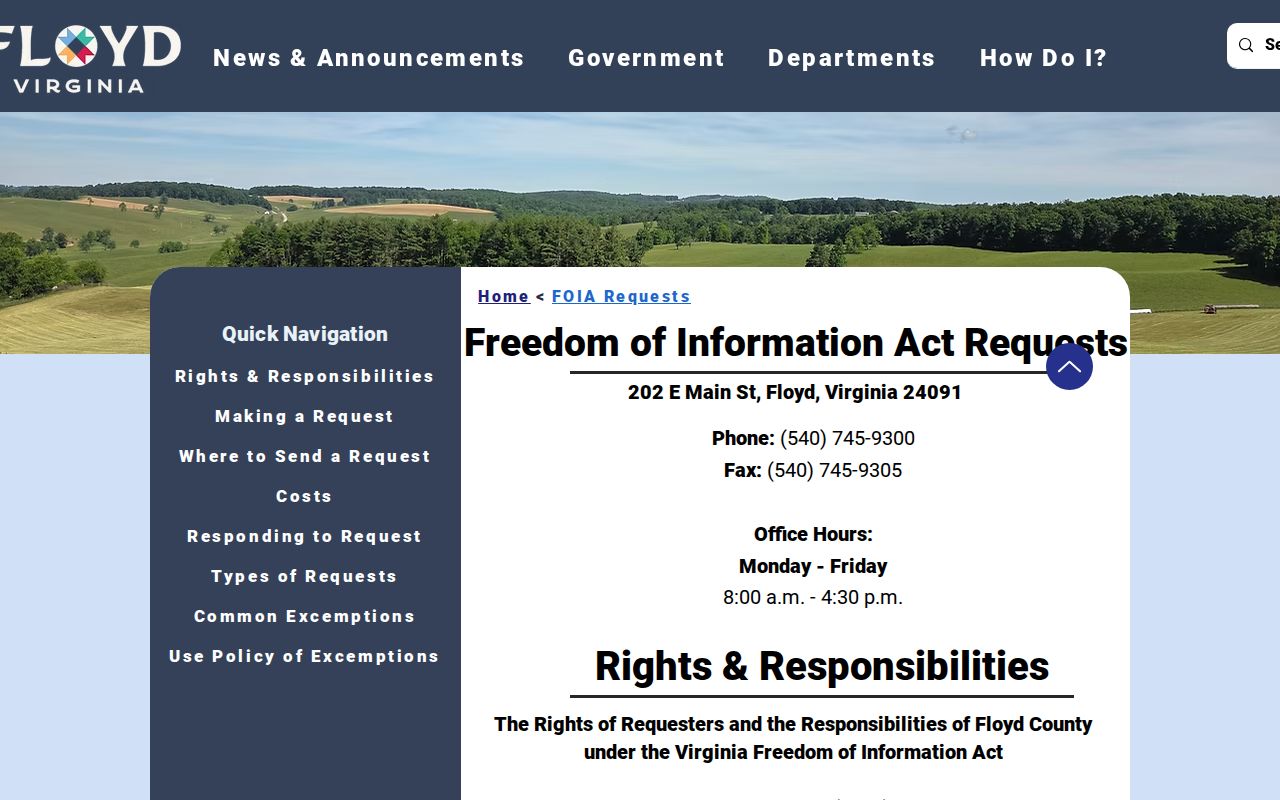
The Floyd County VFOIA page lays out the request process. A request can be oral or written. The county may ask for the requester's name and legal address. It may charge actual search, access, duplication, and supply costs but not general overhead, and it requires advance payment before records are supplied. A requester may seek a cost estimate and set a cost ceiling before work begins.
The county normally responds within five working days. It may produce the record, cite a legal basis for withholding, release a redacted version with the exemption identified, report that the record does not exist, or invoke seven more working days when a timely answer is impracticable. If another public body holds the missing record, the county says it will provide that body's contact information.
The official Floyd records-request page shown here confirms the local channels and response framework.
A narrow description works best. Include the date, place, incident or case number, record type, agency, preferred copy format, and whether an estimate is needed.
The Floyd Municipal Court File
Floyd has no municipal court file because the Town has no municipal court. State-law misdemeanors, traffic matters, and felony preliminary proceedings go to Floyd General District Court in Room 208. Indicted felonies, felony trials, and district appeals go to Floyd Circuit Court in Room 200. Juvenile matters and adult cases within domestic-relations jurisdiction use the combined J&DR court, with confidential juvenile information excluded from public online results.
| Court Name | No Floyd Municipal Court; use Floyd General District, J&DR, or Circuit Court |
|---|---|
| Case Types | General District hears misdemeanors, traffic, and felony preliminary matters; Circuit hears indicted felonies and appeals |
| Lookup Channel | OCIS 2.0, direct General District search, participating Circuit search, or the correct clerk |
| Public Detail | Case number, charge, statute, dates, status, plea, disposition, sentence, costs, and appeal data when displayed |
| Documents | Ask Room 208 or Room 200 for inspection, plain copies, certified copies, and a current fee quote |
The public display is an information source, not a certified file. Pleadings and orders generally require clerk contact. Sealed material, protected identifiers, and confidential juvenile matters do not appear as ordinary public results.
Floyd Criminal Court Docket Rhythm
Local court days give Floyd records a clear weekly pattern. Circuit Court convenes Tuesdays at 9:30 a.m. Its terms begin on the first Tuesday in January, April, July, and October, with grand juries at 9:00 a.m. on the first day. J&DR sits Wednesdays, including adult criminal and arraignment matters within its jurisdiction at 9:30. General District criminal and traffic matters are set Thursdays at 9:00, with attorney matters at 9:30 and no court on a fifth Thursday.
These are docket times, not special records-counter hours. Both Floyd clerk counters publish weekday hours of 8:00 a.m. to 4:30 p.m., and Circuit recording stops fifteen minutes before close. A visitor should inspect the court's portable electronic devices policy before arriving because phones, cameras, or recording devices may be restricted.
Note: Call the clerk before travel because a posted weekly pattern does not guarantee that a particular hearing or file is available that day.
How Floyd Records Reach the County
There is no city layer to pass through. A Floyd County deputy or state trooper creates the incident or arrest report. If custody follows, NRVRJ creates a booking record. A magistrate addresses probable cause and initial release conditions. The General District clerk opens the public case for misdemeanors and felony preliminary proceedings. A certified or indicted felony then reaches Circuit Court, where the clerk tracks pleas, motions, judgment, sentence, and appeal.
Record flow: Floyd County Sheriff or VSP › NRVRJ and Floyd General District Court › Floyd Circuit Court when applicable › Virginia State Police CCRE
The court disposition should return to CCRE so the fingerprint-supported arrest cycle can be paired with its outcome. Timing gaps still occur. A booking can outlast a dismissal in one system, a new case may not yet appear online, and a circuit matter may not be covered by a statewide display. Compare the clerk file with the arresting and custodial agencies when reviewing your own Floyd record.
Search Floyd Criminal Court Records
The Virginia Judiciary OCIS 2.0 Statewide Search is the first broad court index. Select Floyd and the criminal scope, use the defendant's court-record spelling, and inspect the court named on each result. Direct General District and participating Circuit searches provide a second check. Virginia warns that circuit coverage is not universal, so Room 200 remains the Floyd fallback for a felony that should exist but does not appear.
| Search Field | Floyd Use | Common Issue |
|---|---|---|
| Locality | Select Floyd Circuit or Floyd General District | Wrong locality can hide the result |
| Name | Enter last, first, and optional middle name | Spelling must match the court record |
| Case Number | Use the exact court identifier | A felony may have separate district and circuit numbers |
| Hearing Date | Search the date mode where offered | Date format follows the live interface |
| Case Type | Focus on criminal or traffic | Juvenile confidential results are excluded |
Read the details for the charge, plea, status, disposition, sentence, costs, and appeal. A label such as certified means the felony moved toward Circuit Court, not that the person was convicted.
Older Floyd Criminal Records Offline
Some older Floyd files leave the online index. The clerk may need to retrieve a bound book, paper file, or archived entry. The Library of Virginia Floyd County court microfilm inventory can help with genealogy and historical research, but it does not replace the current clerk's case status. Start with a known name, time period, court level, and any old case or book reference.
Floyd's history gives these older records local context. The county was formed from Montgomery County in 1831, and the county seat was first known as Jacksonville before it became Floyd. A record's date can therefore affect which locality name, court book, or archive series should be checked.
The official Floyd County history page provides the background shown below.
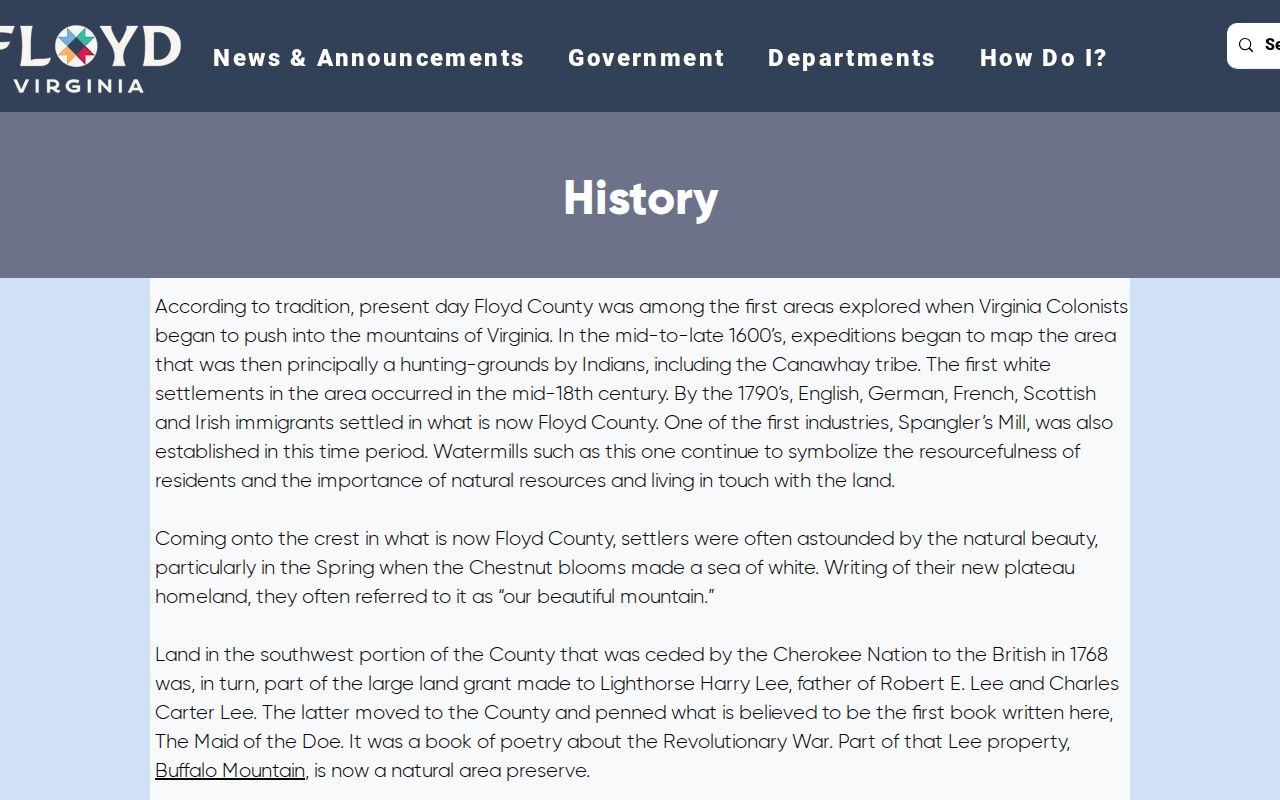
This history is useful for tracing old records, while the present-day court clerks remain the source for a current certified copy.
Floyd Record Access Rules
Access depends on the custodian and record type. Floyd County applies the Virginia Freedom of Information Act to county public records, subject to exemptions and actual-cost charges. Court clerks follow court-record statutes and judiciary rules. VSP CCRE releases compiled criminal-history information only to recipients and for purposes allowed by law. A public court docket can therefore reveal case events that are not available through an open statewide rap-sheet search.
Key Statutes:
Virginia Freedom of Information Act, Section 2.2-3700 et seq. gives qualifying requesters rights to inspect or copy public records, subject to exemptions and actual costs.
Virginia Code Section 17.1-208 addresses clerk custody, inspection, and copies of court records under law and court rules.
Virginia Code Section 19.2-389 limits CCRE dissemination and does not create an unrestricted public rap-sheet database.
Sealed files, confidential juvenile cases, active-investigation material, victim and minor information, and protected personal identifiers can be withheld or redacted. For your own CCRE record, Section 9.1-132 provides an inspection and challenge process. Court and police records may also need separate correction or sealing steps because no Floyd office controls every copy.