
Floyd County Criminal History Checks
No single Floyd County database contains every criminal record. Start with the kind of event and the date. The Virginia Judiciary Online Case Information System, or OCIS 2.0, is the broad first stop for public adult criminal cases. Direct General District and participating Circuit Court searches add a useful cross-check. A very recent arrest may appear first in New River Valley Regional Jail records. An official personal history comes from the Virginia State Police Central Criminal Records Exchange, not from a court screen.
Gather the full name and the spelling used on a summons or warrant. Keep any case number, arrest date, and arresting agency close. A date of birth may help an office distinguish two people, though public court screens limit personal identifiers. Then follow the record to its custodian.
- Search OCIS 2.0 by name, then narrow results to Floyd County and criminal matters.
- Check Floyd General District Court for misdemeanors, traffic cases, and early felony proceedings.
- Check Floyd Circuit Court for indictments, felony trials, district appeals, and final Circuit dispositions.
- Use NRVRJ for present custody, or ask the Sheriff for a local arrest or incident report.
- Ask the right clerk for a plain or certified copy when an online summary is not enough.
Floyd Courthouse Record Counters
Four justice offices share the Floyd County Courthouse at 100 East Main Street, yet each keeps a different part of the record. Circuit Clerk Rhonda T. Vaughn serves the public in Room 200. The Floyd General and Juvenile and Domestic Relations Combined Court clerk is in Room 208. The Sheriff works from Room 206, while the Commonwealth's Attorney is in Room 108. A request sent to “the courthouse” is therefore too broad. The record creator determines the counter.
The official Floyd County home page shows how departments are divided in the source capture below.

The county directory helps route a request before a trip. Court files go to a clerk, local investigative reports go to the Sheriff, and prosecution questions are not a substitute for a clerk record request.
Floyd Circuit Court Clerk
100 E. Main St., Room 200
Floyd, VA 24091
540-745-9330
Monday through Friday, 8:00 a.m. to 4:30 p.m.
Floyd Combined Court Clerk
100 E. Main St., Room 208
Floyd, VA 24091
540-745-9327
Monday through Friday, 8:00 a.m. to 4:30 p.m.
Floyd County Sheriff
100 E. Main St., Room 206
Floyd, VA 24091
540-745-9334
FOIA contact: thollandsworth@floydcova.org
Official Background Checks in Virginia
The Virginia State Police criminal background check channel is the route to CCRE information that state law permits VSP to release. Virginia does not offer an unrestricted public pay-per-name conviction portal. Form SP-167 is the state name-search request. A subject can request their own record, while release to another requester depends on consent, identity steps, and a recipient or purpose allowed by Virginia Code §19.2-389.
The published SP-167 fee is $15 for a Virginia criminal-history name search and $20 for the combined criminal-history and sex-offender name search. Fingerprints reduce same-name errors, but fingerprint checks run through an authorized agency or approved channel. Form SP-325 supports certain statutorily authorized national checks. Floyd County Sheriff can be called about local ink fingerprint-card availability; no official local schedule or charge was published.
| Official product | Published cost | Scope |
|---|---|---|
| VSP SP-167 name search | $15 | Disseminable Virginia CCRE information |
| VSP combined criminal and registry search | $20 | Two Virginia name-search products |
| FBI Identity History Summary | $18 FBI fee | The subject's fingerprint-linked federal history |
| Floyd online court searches | Free | Filed cases, not a compiled rap sheet |
Floyd County OCIS Search Limits
OCIS 2.0 is useful, but the Virginia Judiciary warns that Circuit Court coverage is not universal. A Floyd County felony may first appear in General District Court and later receive a different Circuit Court number after certification or indictment. Multiple charges can also create several result rows. A missing name is not proof that no record exists. Exact spelling, filing delay, confidentiality, or court coverage can all explain the gap.
Use the search controls as a starting point, then call Room 200 for a missing Circuit matter or Room 208 for a district case. Online detail is informational. It does not replace a certified clerk copy.
| Search field | How to use it | Floyd County caution |
|---|---|---|
| Last and first name | Match the court-record spelling | Add the middle name when known |
| Case number | Enter the exact identifier | District and Circuit numbers can differ |
| Court or locality | Select Floyd and the correct court | Check both court levels for a felony |
| Hearing date | Use the interface date format | A date search may miss later transfers |
| Case type | Choose criminal or traffic | Juvenile cases are excluded from public results |
Note: “Certified” on a district felony means the charge moved toward Circuit Court; it does not mean the record copy is certified.
Kinds of Criminal Records
Floyd County criminal records are separate files with separate custodians. The Sheriff or a state trooper creates an incident and arrest report. NRVRJ creates booking and custody data. A magistrate may create warrant, commitment, and bail records. Court clerks preserve filed charges, hearings, orders, outcomes, sentences, costs, and appeals. VSP's CCRE links reportable fingerprint arrests to dispositions that courts send back.
The differences matter. A booking charge can change before prosecution. A court case can exist even when a released person is no longer shown in a current jail search. CCRE dissemination is narrower than public access to some court docket information.
- Arrest report: the enforcement event and investigative narrative, subject to redaction and exemptions.
- Booking record: intake, received charges, bond or holds, custody, and release data.
- Court file: filed charge, plea, motions, disposition, sentence, costs, and appeal.
- CCRE history: fingerprint-linked arrest cycles and reported Virginia outcomes released under state law.
- Custody record: NRVRJ for local custody, VADOC for state custody or supervision, and BOP for federal imprisonment.
Floyd County Custody Records in Dublin
Floyd County has no county-branded online jail roster. A person detained after a local arrest generally enters the New River Valley Regional Jail system at 108 Baker Road in Dublin. That regional facility, not Room 206 at the courthouse, controls current inmate location, visitation, mail, accounts, and release logistics. NRVRJ search results can expose booking identity, custody status, received charges, and bond or hold data, but those entries do not prove the final court result.
After a person enters state custody or adult felony supervision, use the VADOC inmate or supervisee locator. It accepts a DOC ID or a name search and is updated daily with an accuracy warning. The VADOC facilities and offices directory shown below identifies the state facilities and probation or parole offices that serve each region.
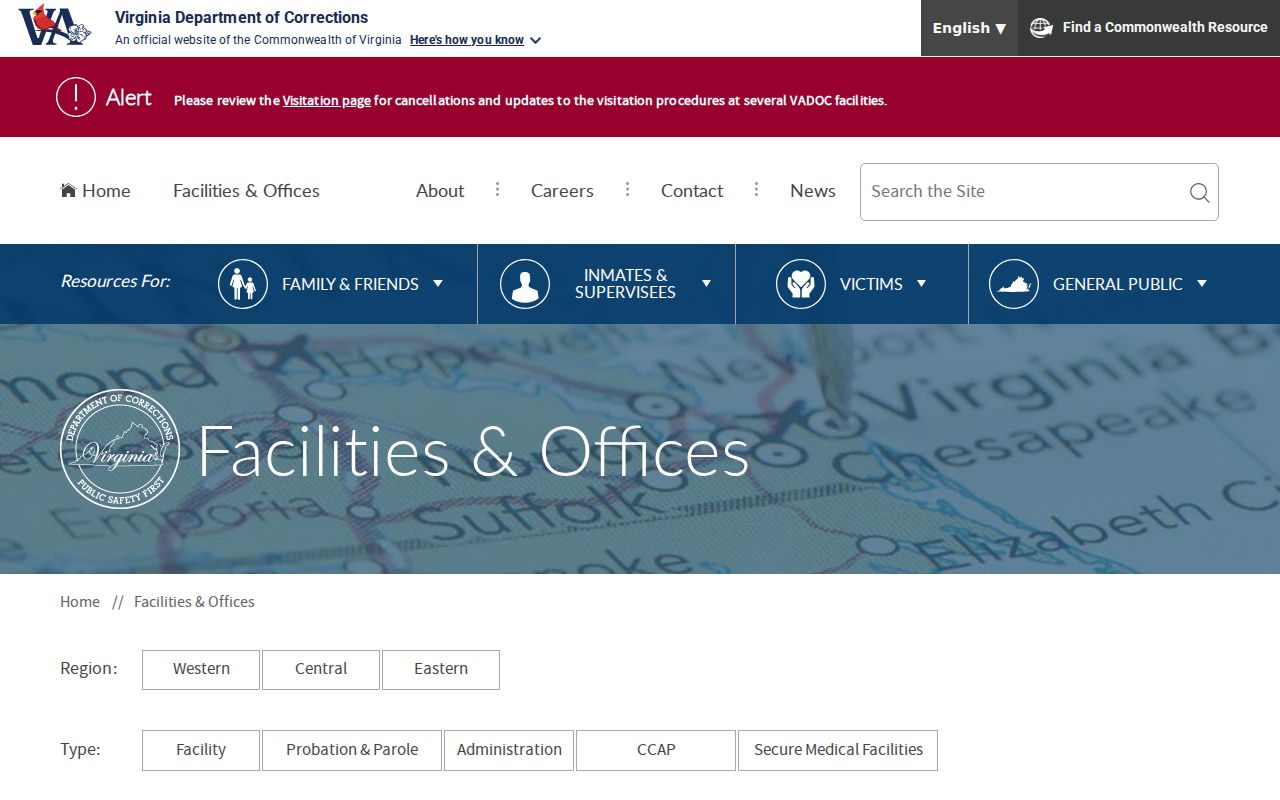
District 28 in Radford serves Floyd County for adult state probation and parole. Virginia VINE is the better tool when the need is custody-status notice rather than a historical file.
Floyd County Criminal Records: What They Contain
The field set depends on the file. A CCRE record centers on identity and arrest cycles. A court file has more hearing and order detail. A booking entry focuses on intake and custody. Public versions can omit a full birth date, Social Security number, victim or minor identity, financial identifiers, sealed material, and active investigative facts.
| Name and identifiers | Legal name, aliases, birth data where allowed, and state or federal identification numbers. |
|---|---|
| Arrest and booking | Agency, dates, transaction or booking number, received charges, bond, holds, and release. |
| Charge details | Offense wording, Virginia Code section, filing court, and amended charge when shown. |
| Case outcome | Plea, guilty finding, acquittal, dismissal, nolle prosequi, and disposition date. |
| Sentence and money | Jail term, suspended time, probation, fine, costs, restitution, and payment status. |
| Later status | Appeal, state custody, release, or supervision when the responsible system publishes it. |
The detail page can be more useful than the result list. It may reveal that a charge was amended or dismissed, or that a felony moved from General District Court to Circuit Court.
Floyd County Federal Criminal Records
Federal matters do not appear as Floyd County cases. The county lies in the U.S. District Court for the Western District of Virginia. Federal dockets use PACER, which requires registration and generally charges ten cents per page, subject to its document cap and quarterly fee waiver. The official PACER entry screen is shown below.
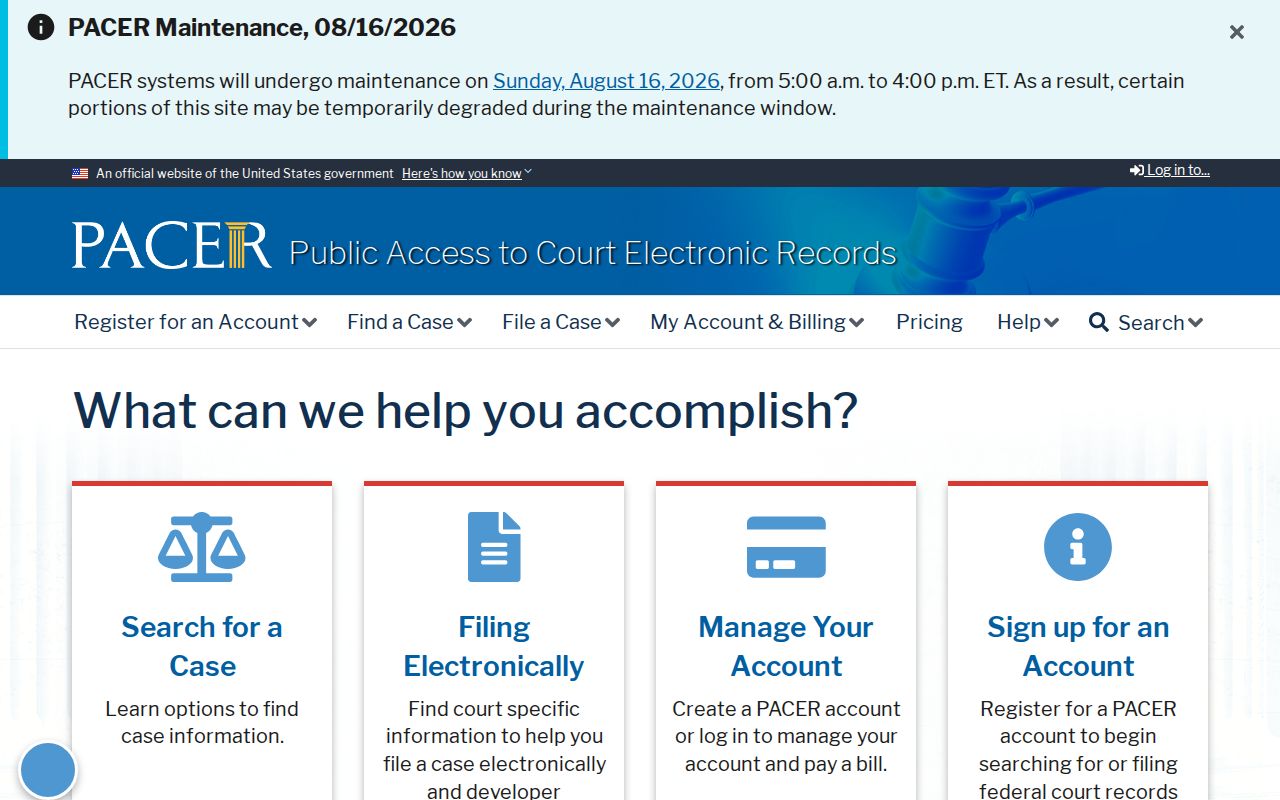
PACER is the authority for public federal dockets, while sealed documents remain unavailable. The Western District of Virginia site lists court locations and local information.
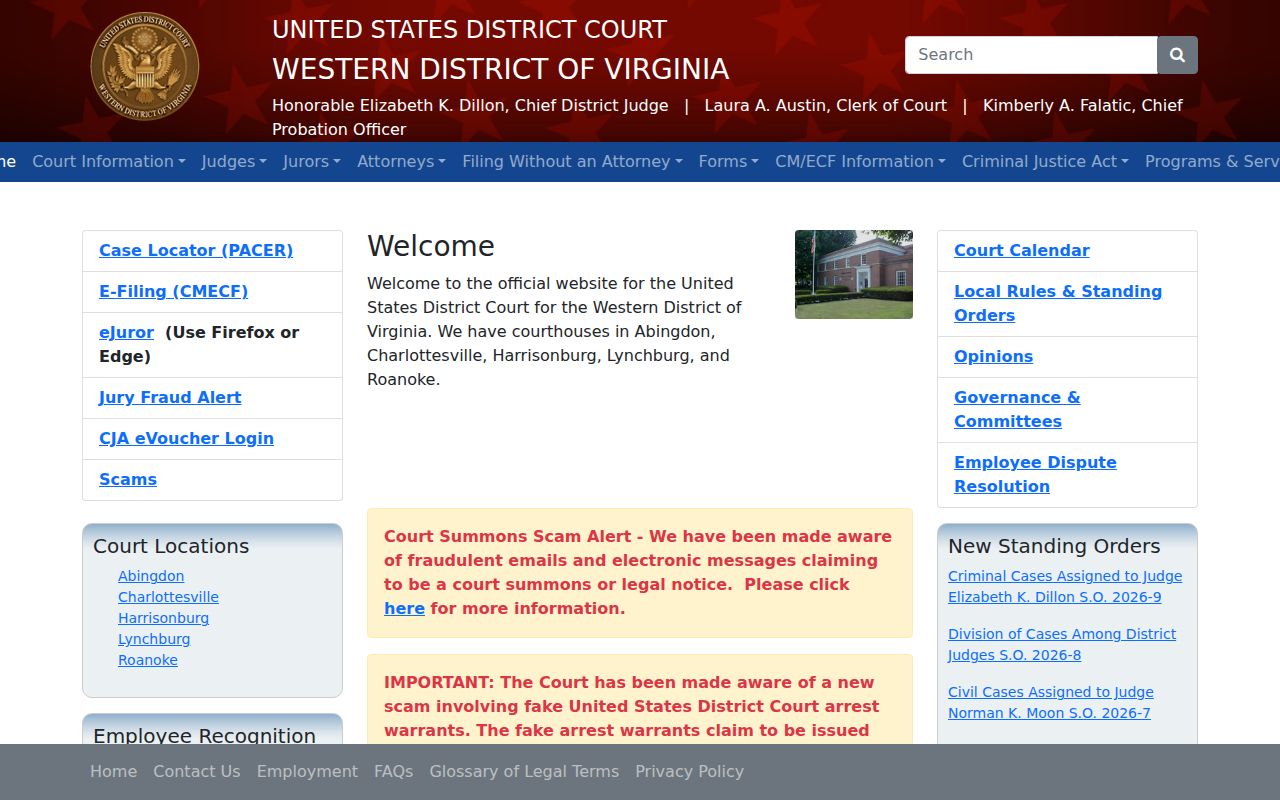
Confirm the current divisional location before travel because a federal filing does not belong at Floyd County Courthouse. Federal custody uses the Bureau of Prisons inmate locator.
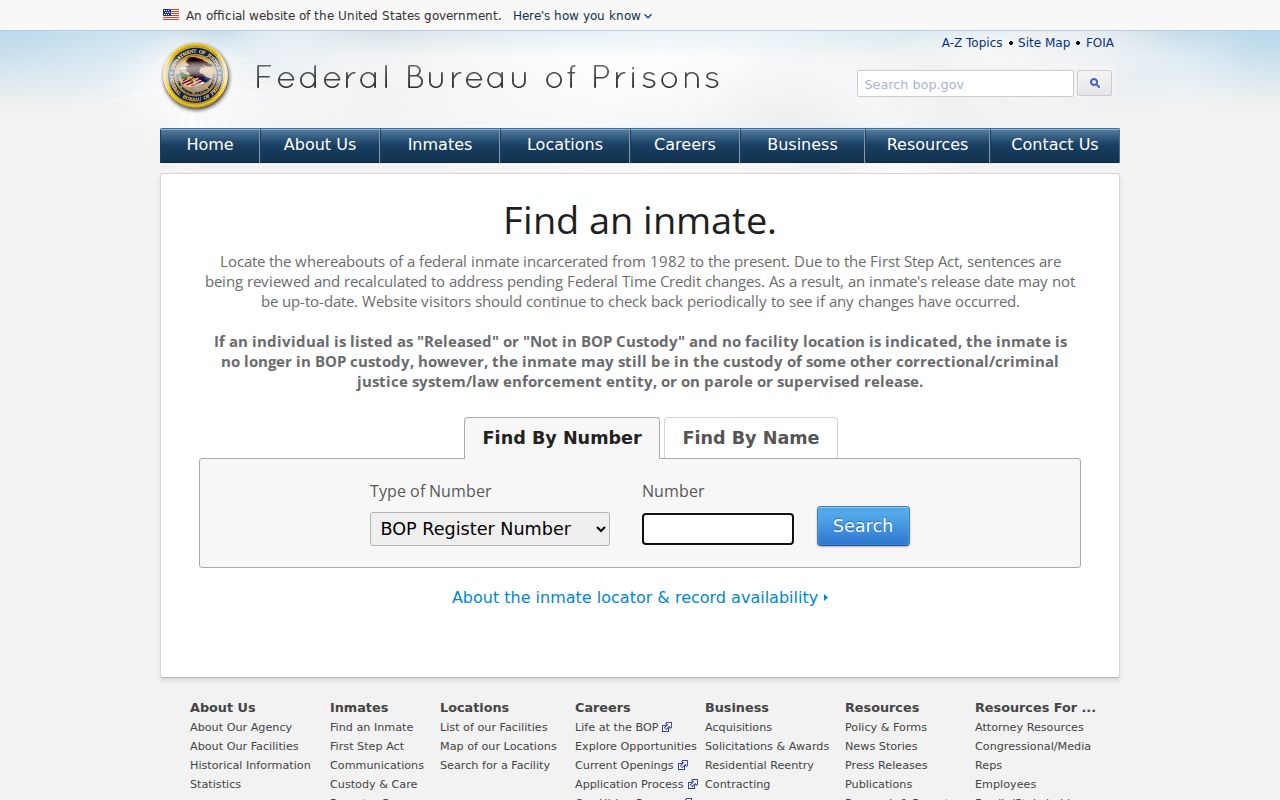
The BOP screen searches federal prisoners by name or register number. It is separate from both NRVRJ and VADOC, and no federal prison was identified inside Floyd County.
Virginia Public Access Laws
Public access changes with the custodian. Floyd County accepts public-record requests under the Virginia Freedom of Information Act, while court clerks also follow judicial and court-record statutes. CCRE is not an open public database because its dissemination law controls who may receive compiled criminal history. Juvenile, sealed, protected-person, and active-investigation records can be unavailable or redacted.
Key Virginia record laws:
Virginia Code §2.2-3700 et seq. gives qualifying requesters access to public records, subject to exemptions and actual costs.
Virginia Code §19.2-389 limits CCRE dissemination to the recipients and purposes listed by law.
Virginia Code §9.1-132 lets a person inspect and challenge their own Virginia criminal history.
Virginia Code §19.2-392.2 governs expungement for qualifying records.
Virginia Code §19.2-392.5 et seq. supplies Virginia's sealing framework.
Floyd County FOIA Record Requests
Floyd County does not require a special online form for Sheriff records. A request can be made by mail, fax, email, phone, or in person. Written requests are often easier to track. Describe an existing record with a date range, location, report number if known, agency, and the precise portion wanted. The county does not have to answer questions or create a new report.
The Floyd County FOIA page describes a five-working-day response category. The county may produce the record, cite an exemption, release a redacted version, say it has no responsive record, or invoke seven more working days when a timely response is not practical. Actual search, access, duplication, and supply costs may be charged. An estimate is available on request, and advance payment is required before release. Send Sheriff report requests to Tara Hollandsworth at thollandsworth@floydcova.org or Room 206.
Note: Booking data belongs to NRVRJ, while filed pleadings and orders belong to the clerk, even when all records stem from one arrest.
Restricted, Sealed & Expunged Records
Virginia keeps expungement and sealing distinct. Traditional expungement under §19.2-392.2 can remove qualifying police and court records after an acquittal, nolle prosequi, certain dismissals, mistaken identity, or an absolute pardon for unjust conviction. A Floyd County petition is filed through Circuit Court, with the proper form, fingerprint and service steps, and certified disposition material as required. The clerk should quote the current filing and service cost because no reliable local criminal fee was published.
Virginia's new sealing framework took effect July 1, 2026. Automatic sealing covers specified non-convictions, traffic infractions, and marijuana matters under the stated rules. Petition sealing can reach certain eligible convictions and deferred dismissals, but the statutes contain broad exclusions and limits. Expungement removes qualifying records. Sealing restricts public access while preserving access authorized by law.
Juvenile case information is not shown in the public online court systems. Sealed material, victim and minor data, full personal identifiers, and some active investigative records are also restricted. An empty public result cannot establish that no protected record exists.
Floyd County Record Corrections
A dismissed charge can remain in an arrest or booking system because those files document the earlier event. Start by reading the Floyd court disposition. If a CCRE entry has the wrong or missing outcome, Virginia Code §9.1-132 gives a person, or their attorney, a route to inspect and challenge their own state criminal history. Contact VSP CCRE and identify the arrest cycle and disputed disposition. Certified court proof may be required.
After a sealing or expungement order, check each custodian that once held the record. That may include the Floyd General District or Circuit Court search, the arresting agency, NRVRJ, and the person's own CCRE review. Provide a certified order to a custodian that still displays the record and follow VSP correction guidance. Updates do not always reach each system at once.
- Nolle prosequi
- The prosecutor chose not to continue that charge at that time; it is not a conviction.
- Dismissal
- The court ended the charge, though the reason and whether it may be refiled matter.
- Expungement
- Qualifying police and court records are removed or destroyed under the governing order.
- Sealing
- Public access is restricted while access allowed by statute may remain.
City-by-City Criminal Records in Floyd County
Floyd County has only one incorporated place, the Town of Floyd. The town has no separate police department, municipal court, jail, arrest blotter, or criminal case portal. Town incidents route to Floyd County Sheriff unless a state officer created the report. Court cases use the same Room 208 and Room 200 channels as the rest of Floyd County. A town-area detainee generally enters NRVRJ in Dublin. That compact structure makes the local guide a routing map, not a duplicate city system.
Floyd Record Check
County seat and only incorporated town · Sheriff policing, county courts, and regional jail custody
Floyd County Historical Court Records
Not every Floyd County criminal record lives on a screen. The county formed in 1831 from Montgomery County, and the Town of Floyd was once called Jacksonville. Older court material can remain in clerk books or require staff retrieval. The Library of Virginia's Floyd County microfilm inventory is a useful path for genealogy and historical research, but it does not establish the current status of a case.
The courthouse also follows a distinct weekly court rhythm. Circuit Court generally convenes Tuesday, J&DR on Wednesday, and General District criminal and traffic matters on Thursday. Counter hours are not the same as hearing times. Before arriving, check the combined court's portable electronic device policy and call the proper clerk about interpreter or access needs. The official sources do not publish a full parking, security, or accessibility plan, so those details should be confirmed rather than assumed.